INTEROPERABILITY THAT CAN BE TESTED
OGC Building Blocks turn data standards into machine-readable rules that can be checked automatically and consistently, with a report as evidence. SURROUND Australia helps organisations design them, profile them to their own rules and put them into operation.
WHAT IS AN OGC BUILDING BLOCK?
A standard a machine can check
An OGC building block is a published, versioned definition of what correct information looks like in a given domain. It is maintained by the Open Geospatial Consortium (OGC) community rather than by any single vendor. Blocks import and profile one another, allowing a community model to be narrowed to a specific jurisdiction or set of business rules without being forked.
Intended for land and survey agencies, infrastructure owners, digital-twin programmes and data-exchange consortia.
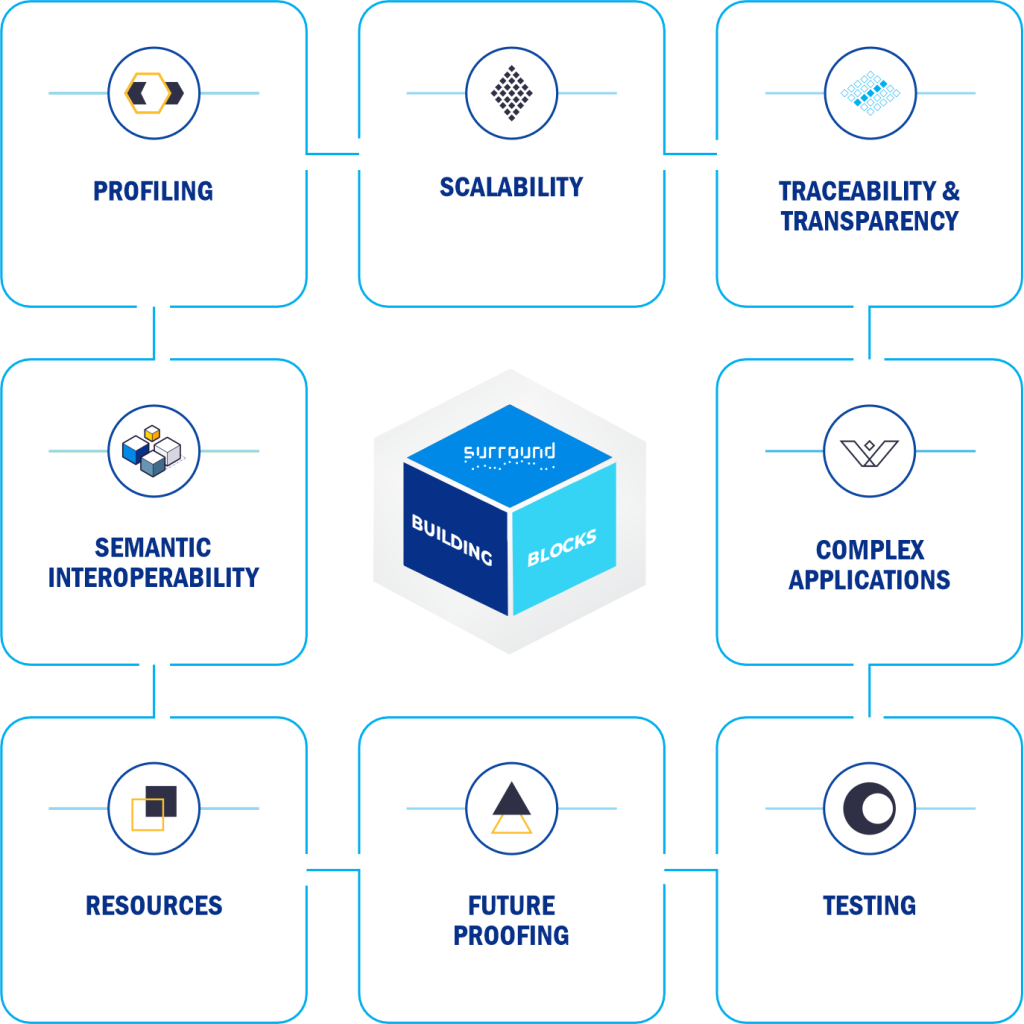
Inside every block



WHY IT MATTERS
From documentation to test execution
Without building blocks
- Standards are held in lengthy PDF documents
- Compliance is a matter of judgement
- Each supplier interprets the specification differently
- Changes to the model cause failures that go unnoticed
With building blocks
- Standards are executable
- Compliance is a pass/fail result, supported by a report
- All parties test against the same versioned register
- Regression tests identify exactly what has changed
CASE STUDY
One cadastral data model, nine jurisdictions
Australia and New Zealand required a single, shared way of describing 3D cadastral survey data across nine land jurisdictions, each with its own rules.
SURROUND Australia led the consortium that developed the 3D Cadastral Survey Data Model and its exchange format for the national surveying committee. The model was delivered across all nine jurisdictions and formally endorsed. Its JSON encoding is now implemented as OGC Building Blocks: a common core with jurisdiction-specific profiles.
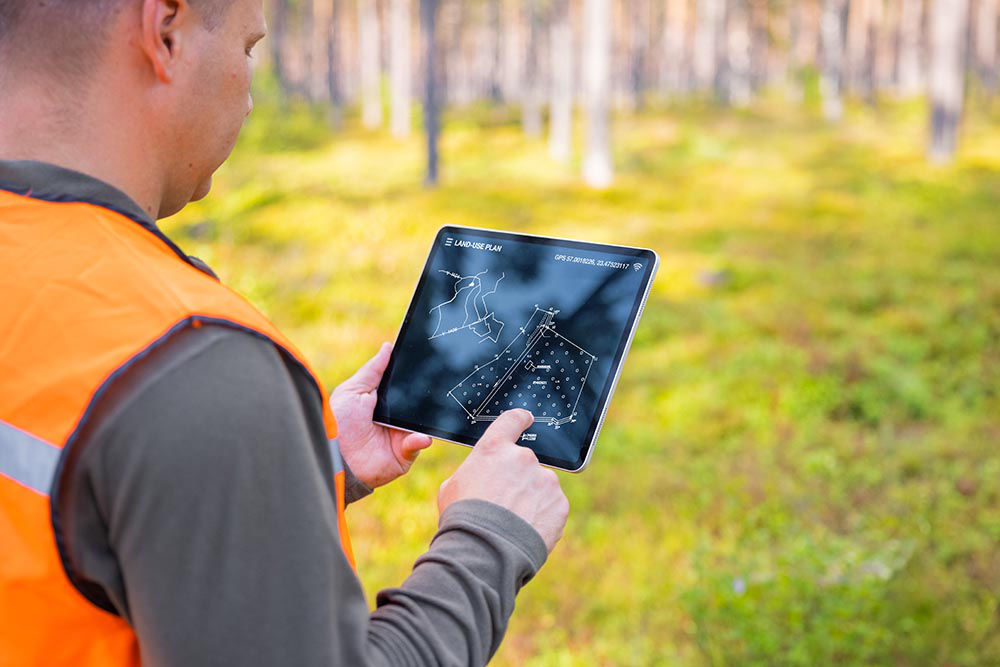
The work continues. Members of the SURROUND Australia team are building validators, transforms and tools in the OGC Building Blocks environment for a state land agency’s next-generation spatial cadastre, enabling surveyors and developers to test their data before lodgement.

TECHNICAL CAPABILITIES
Design, profile, validate, govern

Profiling of client rules
Validators and transforms

Semantic uplift for all contributors

Conformance reporting

Governance and onboarding
Building blocks convert semantic interoperability from a documentation problem into a test-execution problem.”
Rob Atkinson – Lead Ontologist, Surround Australia
Chat with Brad
“Building blocks convert semantic interoperability from a documentation problem into a test-execution problem.”
ROB ATKINSON · LEAD ONTOLOGIST, SURROUND AUSTRALIA
DEEP DIVE: INSIDE A BUILDING BLOCK
What sits inside a building block, and why it matters
Capability. An OGC Building Block is a versioned, machine-readable unit of a standard. It bundles:
- a JSON Schema for structure
- a JSON-LD context that maps every field to a shared meaning
- SHACL shapes for the rules
- worked examples and test resources, including negative tests that must fail for the block to pass
Registers of blocks are published as static resources accessible over HTTP. Blocks import and profile one another, so a community model can be narrowed to a jurisdiction, tenant or business rule set without being forked.
How validation works. The pipeline runs in a fixed order:
- JSON Schema validation
- Semantic uplift to JSON-LD and RDF
- SHACL validation
- Any plugin validators
Results are written to a report. The diagnostics are graded, so they serve both as a repair signal for systems (and AI agents) and as an evidence trail for auditors. Because the register’s own continuous integration proves the bundled examples valid, the specification, the examples and the tests cannot drift apart.
Highlights.
- Cadastral model: SURROUND Australia led the consortium that developed the 3D Cadastral Survey Data Model and exchange format for Australia and New Zealand. It was delivered across all nine jurisdictions and endorsed nationally, and its JSON encoding is now implemented as OGC Building Blocks with a common core and jurisdiction profiles.
- Current work: members of the SURROUND Australia team are building validators, transforms and tools in the Building Blocks environment for a state land agency’s next-generation spatial cadastre.
- Standards lineage: GeoSPARQL 1.1, OGC Testbed-16 discrete global grid work, and reference implementations of the OGC Linked Data API and an OGC API for discrete global grids.
Building blocks for AI agents. The same approach makes agent output testable. A block acts as:
- an oracle: an automatic check on what an agent produces
- grounding: its full description and examples form the agent’s context
- a capability contract: an agent’s competence can be declared as a set of block identifiers at given versions
Combined with continuous benchmarking, such as 2pi Software’s VERSDBench (a general-purpose evaluation tool that works with any AI system), this allows organisations to re-run the same test set whenever a model changes. Validation demonstrates that output is well-formed and internally consistent; it does not demonstrate that the content is true, and SURROUND Australia designs for both.
Client benefits.
- Conformance becomes a pass/fail result supported by a report, rather than a matter of judgement.
- Every supplier tests against the same versioned register.
- The impact of changes to a model is shown immediately through regression tests.
- The client’s own rules, encoded as profiles of community models, become a distinctive asset that remains interoperable with the wider standard.
FUTURE DIRECTION
Accountable AI agents
The same approach makes AI agents accountable. A building block can check an agent’s output automatically, ground the agent in the specification itself, and serve as a testable contract for what the agent is able to do. Combined with continuous benchmarking, such as 2pi Software’s VERSDBench, the same tests are re-run whenever a model changes.
Validation demonstrates that output is well-formed and internally consistent. It does not demonstrate that the content is true, and SURROUND Australia designs for both.
NOTABLE TEAM ACHIEVEMENTS
Standards work behind the service
- OGC GeoSPARQL 1.1: SURROUND Australia was a submitting organisation and provided the reference implementation for discrete global grid functions.
- OGC Testbed-16: discrete global grid system catalogue and reference implementations.
- OGC API and Linked Data: reference implementations of the OGC Linked Data API and an OGC API for discrete global grids.
- OGC Definitions Server: operates on vocabulary-publishing software that originated at SURROUND Australia.
METHODOLOGY
Four steps to a testable standard
Standards review
An assessment of where the client’s data meets its obligations, and which building blocks already exist.
Profiling and prototyping
The client’s rules expressed as profiles, with examples and failing tests, in a working register.
Validation in the pipeline
Conformance checks integrated into the client’s data flows and CI, with reporting.
Governance and growth
Versioning, onboarding and support as the standard and the client’s systems evolve.
A standard that cannot yet be tested?
SURROUND Australia can convert it into a standard that every party can test, starting with the data, the rules and the parties that depend on them.