KNOWLEDGE THAT CAN BE TRACED
SURROUND Australia designs the ontologies, vocabularies and knowledge graphs that give an organisation’s data, and the AI built on it, a shared meaning, rules that can be tested, and provenance that can be followed.
SEMANTIC SOLUTIONS
A problem of meaning, not of data
In many organisations, the same asset, person or place is described in different ways across different systems. Business rules are held in individual knowledge or in documents. When an AI system answers a question, it is often difficult to establish where the answer came from.
An ontology addresses this at the root, making the meaning of an organisation’s data explicit, shared and machine-checkable. SURROUND Australia has spent many years building semantic systems for government and industry, from national data repositories to international standards.
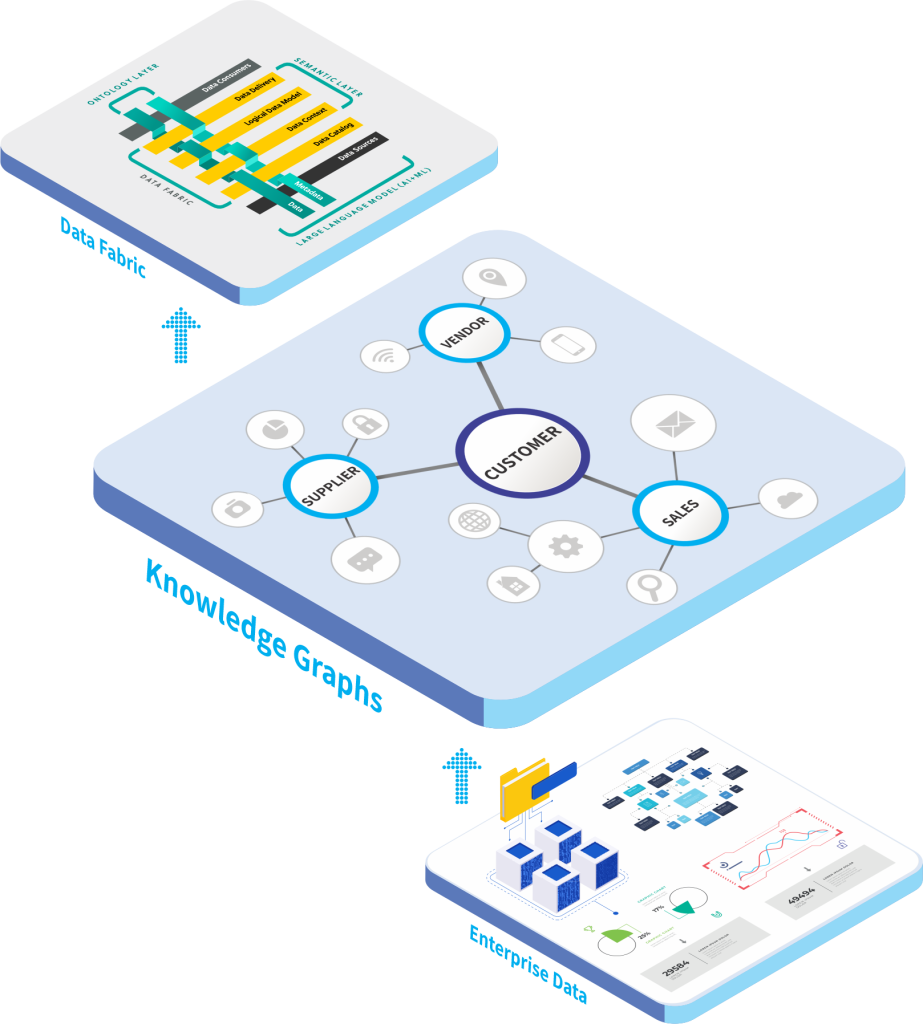
Once meaning is explicit, organisations can




TECHNICAL CAPABILITIES
From initial model to production knowledge graph
SURROUND Australia works to open W3C and OGC standards throughout (OWL, SKOS, SHACL, PROV and GeoSPARQL), delivering on Stardog, with Apache Jena/Fuseki where an open-source stack is the better fit.

Ontology and vocabulary engineering

Knowledge graph design and build
Validation by profile
Provenance and transparency

Linked Data publication

Knowledge graphs for trustworthy AI
PROVEN IN PRODUCTION
CASE STUDIES
A national biodiversity data repository
Challenge. Biodiversity observations arriving from multiple jurisdictions in inconsistent formats.
Deliverable. A governed semantic graph service, built and operated by SURROUND Australia for the Australian Government environment portfolio, validating data against national standards.
Result. More than 1.5 million records published under Commonwealth persistent identifiers.
A national vocabulary service, UK
Challenge. A national marine and environmental vocabulary service requiring robust, standards-based publication.
Deliverable. SURROUND Australia’s vocabulary publication software, together with the publishing profile and validators developed with the client.
Result. In continuous service since 2022.
One cadastral model, nine jurisdictions
Challenge. Nine land jurisdictions describing 3D survey data in different ways.
Deliverable. Leadership of the consortium that developed the 3D Cadastral Survey Data Model and exchange format.
Result. Delivered across all nine jurisdictions and endorsed nationally.
Intelligent records classification
Challenge. Government records requiring classification and sentencing at scale, on a defensible basis.
Deliverable. A machine-learning and ontology pipeline capturing provenance for every decision, hosted in an environment designed to PROTECTED-level controls.
Result. A proof of concept demonstrating automated, auditable records sentencing.
DEEP DIVE: THE STACK
Built on open standards, built to be checked
Capability. SURROUND Australia designs and delivers semantic data infrastructure based on open W3C standards. Domain models are expressed in OWL and SKOS, data rules as SHACL shapes, and lineage is recorded using the PROV ontology. The result is a knowledge graph that applications, analysts and AI systems can query through SPARQL and GraphQL. The company’s current delivery platform is Stardog, with Apache Jena/Fuseki used where an open-source stack is the better fit. Because the models are standards-based, they remain independent of any single product choice.
Architecture. A typical engagement establishes four layers:
- ontologies and controlled vocabularies that define the domain
- validation profiles that make those definitions enforceable
- an ingestion and semantic-uplift pipeline that converts source data into linked data
- a publication layer that serves vocabularies, catalogues and datasets under persistent identifiers
Developers can submit plain JSON or CSV to the pipeline while data modellers work in ontologies and SHACL, allowing each group to work in its preferred way within common boundaries.
Highlights.
- Standards authorship: members of the SURROUND Australia team contributed to OGC GeoSPARQL 1.1 and edited the W3C Profiles Vocabulary.
- National biodiversity repository: SURROUND Australia built and operated a governed semantic graph service for the Australian Government environment portfolio, harmonising observations from multiple jurisdictions, validating them against national standards and publishing more than 1.5 million records under Commonwealth persistent identifiers.
- UK national vocabulary service: SURROUND Australia’s vocabulary publication software has supported the United Kingdom’s national marine and environmental vocabulary service since 2022.
- Open-source tools: several tools that originated at SURROUND Australia, including VocPrez, Prez, pyLODE and Cheka, remain in active community use.
Governance and provenance. The promotion of new or generated data can trigger governance workflows for the roles responsible for it. Every load, transformation and inference can be recorded in the graph as provenance (entity, activity and agent), making lineage navigable rather than buried in log files. This is of particular value where decisions are subject to audit, and where AI systems must cite the facts on which they rely.
Client benefits.
- Lower integration costs, as systems share meaning rather than relying on point-to-point mappings.
- Measurable data quality, as rules are executed as tests.
- Published data that remains reusable and citable over the long term.
- AI responses grounded in governed facts, with supporting evidence attached.
- Client ownership of the models, which are open, portable and independent of any single vendor.
METHODOLOGY
Start small, prove value, then scale
Semantic assessment
A short, fixed-scope review of the client’s data landscape, identifying where meaning breaks down and which standards apply, with a costed roadmap.
Modelling and validation
Ontologies, vocabularies and SHACL profiles for the client’s domain, supported by test data and documentation.
Knowledge graph build
A working knowledge graph over the client’s priority sources, hosted in the client’s cloud, with ingestion, validation and provenance built in.
Publication and governance
Linked Data publication, persistent identifiers and governance workflows that keep the model current as the organisation evolves.
Managed operation
Hosting, monitoring and support on Australian infrastructure, delivered with SURROUND Australia’s long-standing partner, 2pi Software.
NOTABLE TEAM ACHIEVEMENTS
Contributing to the standards others build on
- OGC GeoSPARQL 1.1 (published 2024): SURROUND Australia was a submitting organisation; members of its team led the editing and provided the reference implementation for discrete global grid functions.
- W3C Profiles Vocabulary (2019): edited by members of the SURROUND Australia team.
- Contributions to the W3C Dataset Exchange Working Group, ISO TC 211 and the Australian Government Linked Data Working Group.
OPEN SOURCE
Tools relied on by the wider community
Several widely used Linked Data tools originated at SURROUND Australia, including VocPrez, Prez, pyLODE and Cheka, and are now maintained by the wider community.
VERIFIABLE READINESS
Transparent technology readiness
SURROUND Australia grades its own technology against the Defence Technology Readiness Level scale, and provides clients with the readiness level of each component, and the supporting evidence, before they rely on it.

Data that does not align across systems?
SURROUND Australia provides a candid assessment of whether an ontology is the right solution, and what implementation would involve.