DATA THAT KEEPS ITS MEANING
The SURROUND Australia Interoperability Framework connects organisations, systems and AI agents through open OGC standards that machines can read, test and trust, so data means the same thing wherever it goes.
INTEROPERABILITY FRAMEWORK
A system-of-systems data reference model, built on open global standards
Data can usually be exchanged. The failures happen when it is exchanged without a shared understanding of what it means: units that are never declared, coordinate systems that are assumed, feature types that only make sense locally. People notice some of these gaps. AI agents fill them by guessing.
The SURROUND Australia Interoperability Framework closes those gaps. It enables organisations, systems and applications to connect, exchange and analyse enterprise data regardless of source, schema or format. Built on globally recognised Open Geospatial Consortium (OGC) standards, it supports the FAIR principles, making data findable, accessible, interoperable and reusable, as well as trusted and transparent.
HOW IT FITS TOGETHER
Four connected parts, tested and traced end to end
The framework follows the architecture set out in the OGC’s 2026 research paper on machine-interpretable standards. Each part is useful on its own and can be adopted one step at a time. Conformance testing and provenance run through all four, so every result can be checked and traced.
Machine-readable standards
Profiles
OGC Building Blocks

Registers
Conformance testing

Provenance and trust
WHAT THE FRAMEWORK DELIVERS
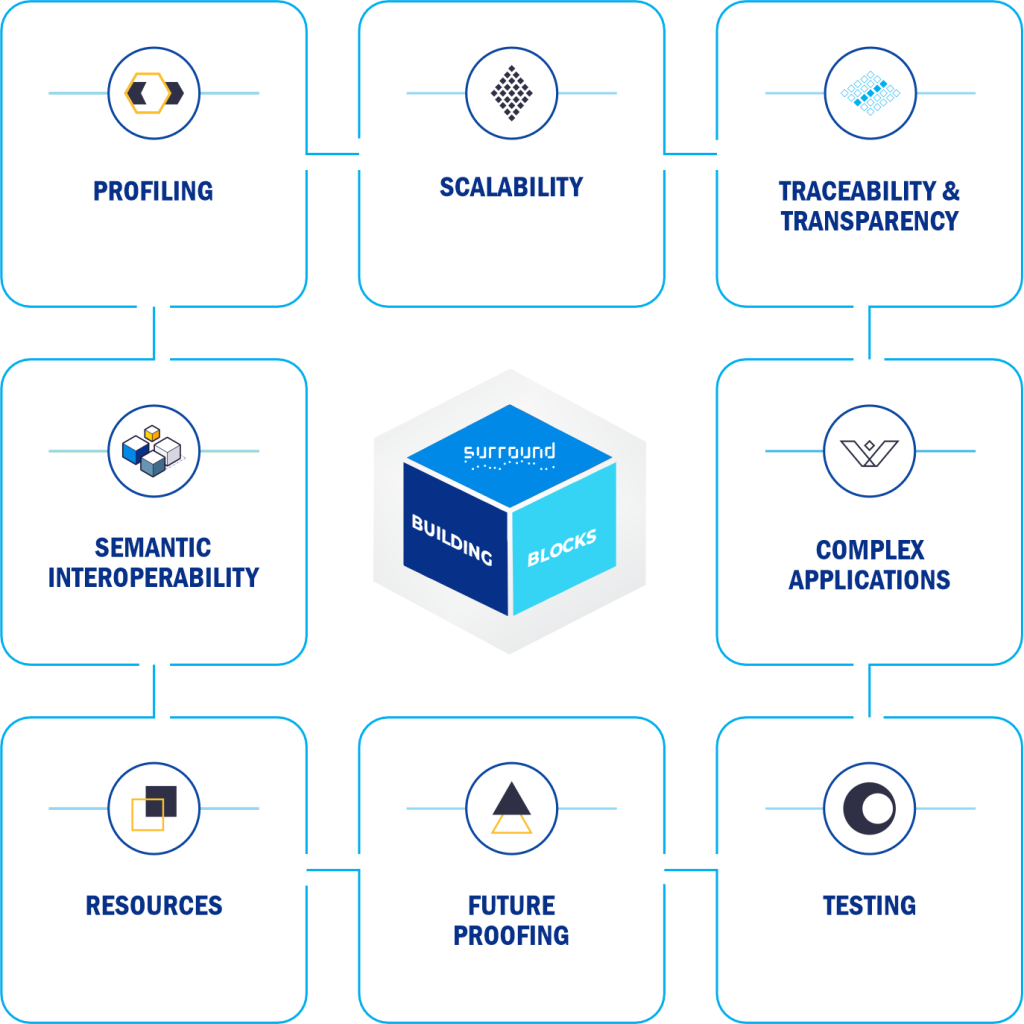
Eight qualities, one framework



WHY IT MATTERS
Declared meaning, not inferred meaning
Without a shared framework
- Every pair of systems needs its own integration
- Units, formats and coordinate systems are assumed
- AI agents infer meaning, and errors go unnoticed
- Compliance is reported as a conclusion in a PDF
With the framework
- Systems integrate once, against a shared profile
- Every value arrives with its meaning declared
- Agents check their own output against declared rules before acting
- Auditors can inspect the logic and provenance behind a result
THE FOUNDATION
Where OGC Building Blocks fit
OGC Building Blocks are the working parts of the framework. Each one packages a piece of a standard, including its schema, shared meaning, validation rules and worked examples, so that it can be tested automatically and reused across domains.
SURROUND Australia designs building blocks, profiles them to a client’s own rules and wires the validation into everyday data flows. Read more about our OGC Building Blocks service.
The framework also underpins our Ontology & Knowledge Graphs work, and it gives the AI systems in the VERSD Suite data they can rely on.

BUILT FOR AI
AI reliability is a data question
An AI agent is only as reliable as the meaning of the data it consumes. When that meaning is implicit, the agent has to guess, and guesswork at the semantic layer is where hallucinations and silent errors begin.
When data is published against a registered profile, every value carries its meaning in a form an agent can use safely. The agent can check its interpretation against the declared rules before it acts, turning an unpredictable failure into one that can be detected and fixed.
What this means for clients:
- Lower integration cost: a new partner becomes a small registered adjustment to a shared profile, not a new integration project.
- Auditable reporting: regulators and auditors can follow the baseline, definitions and processing chain behind a reported figure.
- Less vendor lock-in: data contracts are built from public, registered components, so changing providers becomes a mapping exercise.
- AI that can be deployed: agents working on third-party data in high-stakes settings can validate before they act.
STANDARDS LEADERSHIP
Helping to shape the standards
Rob Atkinson, SURROUND Australia’s Lead Ontologist, is a co-author of the OGC’s 2026 research paper The Machine-Interpretable Standards Ecosystem (OGC 26-021), which sets out the architecture this framework follows.
SURROUND Australia’s standards record includes GeoSPARQL 1.1, OGC Testbed-16 and reference implementations of OGC APIs, and building blocks now encode the 3D cadastral survey data model used across Australia and New Zealand.
METHODOLOGY
Four steps to interoperability
Assess
Map the systems, data flows and obligations involved, and the standards and building blocks that already exist.
Profile
Express the client’s rules as profiles of community standards, with examples and tests, in a working register.
Validate
Build conformance checks into data pipelines and AI workflows, with reports as evidence.
Govern
Version, register and support the profiles as standards, partners and systems change.

Systems that don’t understand each other?
SURROUND Australia can help them share data with its meaning intact, starting with the systems, the rules and the people who depend on them.